Guides
AI Voice Agent Pricing for BFSI: Outcome Models
Explore AI voice agent pricing for BFSI, including per-minute rates, outcome-based models, hidden fees, and total cost of ownership.

AI voice agent pricing spans a wide range, from $0.07 to $1.00 per minute on standard platforms, but BFSI operations require a sharper lens. Collections workflows, EMI follow-up, promise-to-pay tracking, and consent-gated outbound calling all carry compliance overhead that generic per-minute rates ignore. DubCall is built for exactly that context, pairing outcome-based billing with the audit trails and DNC controls that banking and insurance teams need before signing any vendor agreement.
What AI Voice Agent Pricing Actually Covers in BFSI
Headline per-minute rates cover connected call time. Nothing else. Everything a BFSI operations team actually needs, from consent capture to SOC 2 logging, sits in adjacent line items that most sales decks skip.
The eight cost components beneath the headline rate
A realistic BFSI cost model has to price each of the following separately:
- Per-minute calling cost for connected time only.
- Setup and onboarding, which Acefone's 2026 India analysis puts at ₹1 lakh to ₹5 lakh before the first outbound call is placed.
- Platform subscription, ranging from ₹5,000 to ₹50,000+ per month in India, separate from usage.
- Telephony transport (Twilio, Vonage, Telnyx) billed by the carrier, not the platform.
- Compliance add-ons: PII redaction, SOC 2 audit logging, DNC scrubbing, consent capture.
- Concurrency beyond the base package.
- Integration with core banking, LOS, or collections management systems.
- Support tier and SLA level.
How BFSI workloads inflate standard per-minute costs
Inbound and outbound rates diverge. Outbound COD confirmation, EMI reminder, and promise-to-pay follow-up almost always cost more than inbound support minutes. Billing clocks vary too: some vendors start timing when the call is placed (including ring time), others when the customer answers. At 10,000 calls per month, a 10-second gap compounds into a material invoice difference.
Takeaway: Treat the per-minute rate as one line item out of eight. If a vendor cannot itemize the other seven, the quote is not yet a quote.
Headline Cost Ranges: A 2026 Market Snapshot
Per-minute rates across major platforms
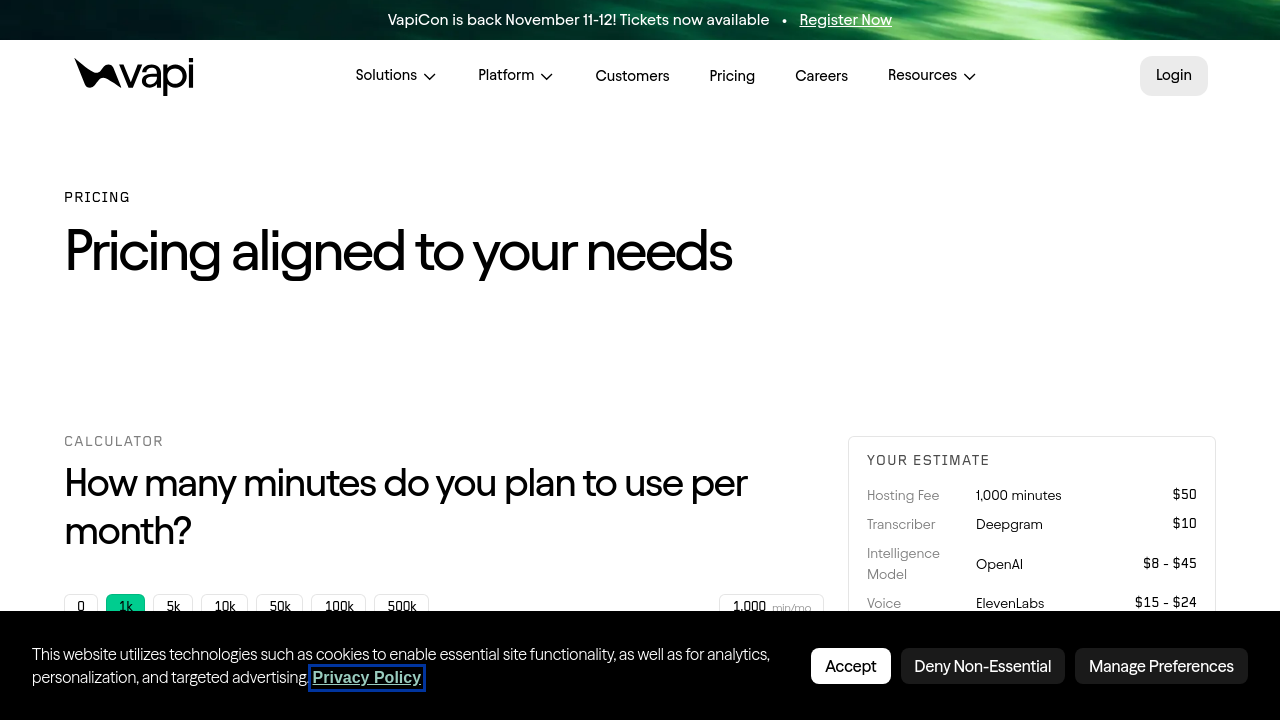
Global per-minute rates run from $0.07 to $0.31 on pay-as-you-go platforms like Retell AI, and from $0.05 to $1.00 across the broader market per Aircall's 2026 pricing breakdown. Vapi's built-in estimator puts a 1,000-minute monthly workload at roughly $82 to $129 all-in, once Deepgram transcription, an OpenAI intelligence model, and ElevenLabs voice synthesis are stacked on top of the $50 hosting fee, per Vapi's public pricing page.
Aircall's own AI Voice Agent PAYG tier is priced at $0.99 per minute, with a Lite plan at $99 per month for 100 minutes and overages that revert to $0.99. Subscription tiers for mid-market teams typically land at $600 to $1,200 per month, putting effective per-minute cost at $0.12 to $0.24 once volume is factored in, per Famulor's April 2026 platform comparison.
India-specific pricing benchmarks
In India, per-minute rates for AI voice bots range from ₹0.80 to ₹3.00 depending on vendor, volume commitment, and call direction, per Acefone's August 2026 report. Setup fees sit outside that range and are rarely disclosed in the first sales conversation.
Takeaway: Anchor your budget conversation on effective per-minute cost after subscription, transport, and compliance, not the number on the sales slide.
Pricing Model Structures: Which One Fits BFSI
Pay-as-you-go vs. subscription vs. outcome-based
Three models dominate:
- Pay-as-you-go. Retell at $0.07 to $0.31 per minute is representative. Flexibility is real; predictability is not. Collections cycles spike month-end, and PAYG invoices spike with them.
- Subscription bundles. $29 to $999 per month base plus per-minute overages. Suits stable inbound volume; penalizes seasonal BFSI outbound campaigns with overage rates.
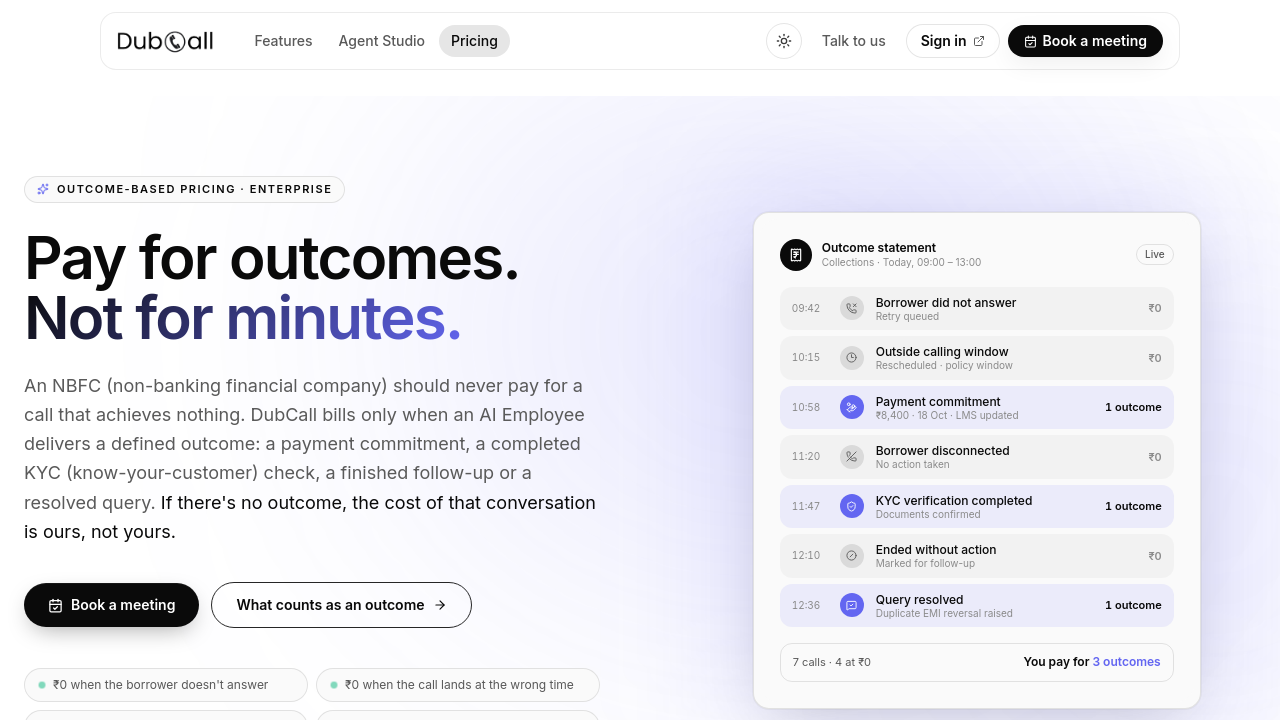
- Outcome-based. Charges tied to defined results: a completed promise-to-pay, a confirmed EMI date, a resolved dispute. Vendor incentives align with lender outcomes rather than dial time.
The brand's outcome-based pricing model is designed for the third pattern, which is where BFSI economics actually live.
Why outcome-based billing suits collections and EMI follow-up
Collections teams already measure themselves on promise-to-pay conversion, right-party contact rate, and cure rate. Paying per minute rewards long calls; paying per outcome rewards the metric the recovery manager already reports upstream. Sales-focused AI agents also cost 20 to 30 percent more than support agents due to deeper CRM integrations and lead qualification logic, per Aircall's 2026 breakdown, so outcome pricing removes the argument about which category an EMI follow-up call belongs in.
Concurrency matters here too. Retell includes 20 concurrent calls on PAYG; Vapi's base tier allows 4, scaling to 30 on the Pro plan at $999 per month. A collections campaign that dials 500 accounts inside a 30-minute window needs concurrency headroom priced in from day one. Configuring that concurrency inside a purpose-built AI calling agent is a different conversation from adding it as an overage.
Takeaway: Match the pricing model to the workload rhythm. Steady inbound = subscription. Bursty outbound with measurable outcomes = outcome-based.
Hidden Fees and Total Cost of Ownership
The gap between headline rate and monthly invoice is where most BFSI procurement teams get burned. The recurring culprits:
| Cost line | Typical charge | When it hits |
|---|---|---|
| Twilio inbound transport | $0.008 / min | Every inbound minute |
| Twilio outbound transport | $0.014 / min | Every outbound minute |
| Vapi HIPAA-eligible handling | $2,000 / month | Health-insurance BFSI segments |
| Vapi extra concurrency | $10 / line / month | Beyond base package |
| Vapi extra organizations | $20 / org / month | Multi-product-line banks |
| Custom DPA / BAA / MSA | Enterprise plan only | Data-residency clauses |
| Core banking / LOS integration | Custom dev, billed separately | Go-live |
Custom DPA, BAA, and MSA negotiation is reserved for enterprise plans across most platforms. Smaller BFSI teams often cannot get contractual data-residency guarantees without committing to minimum spend, which distorts the total cost model far more than the per-minute number.
Takeaway: Ask for a written line-item quote covering transport, compliance, concurrency, and integration. If any of the four is missing, the number in the sales deck is not the number you will pay.
How to Build an Accurate BFSI Cost Model Before Signing
The five questions to ask every vendor
- When does the billing clock start? Ring-time inclusion at 10,000 calls per month can silently add 10 to 15 percent to the invoice.
- Do you have separate inbound and outbound rate cards? Collections and EMI follow-up are predominantly outbound; blended rates usually understate outbound cost.
- Are DNC scrubbing, consent logging, call recording, and PII redaction included? For RBI-regulated outbound in India, these are non-negotiable, not add-ons.
- What is the concurrency ceiling and the overage cost? Undersizing concurrent lines causes queue delays that erode promise-to-pay conversion.
- Will you provide a total-cost-of-ownership sheet? Setup, platform, transport, compliance, integration. Not just per-minute.
Building a realistic monthly cost projection
Start with expected connected minutes per month, split inbound and outbound. Layer transport at $0.008 to $0.014 per minute. Add subscription. Add compliance premiums for the specific product line, health insurance or credit card collections behave differently. Add concurrency overage against peak-hour demand, not average. Add integration amortized over 12 months. The realistic number typically lands 40 to 60 percent above the headline per-minute rate.
Configuration matters here as much as pricing. Building call flows in an agent studio that exposes DNC checks, consent prompts, and promise-to-pay capture as native components keeps compliance costs inside the platform rather than sitting on a separate invoice.
Takeaway: A one-page TCO model built before the RFP closes is worth more than any discount negotiated during it.
Conclusion: Match the Pricing Model to the Outcome
Per-minute pricing is a useful entry point but a poor long-term metric for BFSI. Outcome-based billing, tied to EMI confirmations, promise-to-pay rates, or resolved disputes, aligns vendor cost with lender business results. Total cost of ownership in BFSI routinely runs 40 to 60 percent above the headline per-minute rate once telephony, compliance, and integration are added. Teams that define success metrics, conversion rate, containment rate, agent deflection, before procurement negotiate stronger SLAs and avoid overage traps. That is the frame DubCall builds pricing around: measurable outcomes, itemized compliance, and a TCO number that survives contact with the invoice.
FAQ: Frequently Asked Questions
How much does an AI voice agent cost per minute in 2026?
Global rates run from $0.05 to $1.00 per minute. Pay-as-you-go platforms like Retell sit at $0.07 to $0.31. In India, rates fall between ₹0.80 and ₹3.00 depending on vendor, direction, and volume commitment.
What is outcome-based pricing for AI voice agents?
Outcome-based pricing charges for defined business results rather than minutes consumed. In BFSI that typically means a completed promise-to-pay, a confirmed EMI date, or a resolved dispute. Vendor incentives align with the metrics collections managers already report.
How are AI voice agent costs different for BFSI compared to other industries?
BFSI adds compliance overhead: DNC scrubbing, consent logging, PII redaction, call recording, SOC 2 audit trails, and data residency clauses. These add 40 to 60 percent to the effective per-minute rate versus a generic support deployment.
What hidden fees should I watch for in AI voice agent contracts?
Telephony transport ($0.008 to $0.014 per minute on Twilio), HIPAA handling premiums (Vapi charges $2,000 per month), concurrency add-ons ($10 per line on Vapi), extra organizations, integration development, and custom DPA or BAA negotiation gated to enterprise tiers.
What does AI voice agent pricing look like in India?
Per-minute rates range from ₹0.80 to ₹3.00. Setup fees run ₹1 lakh to ₹5 lakh per Acefone's 2026 analysis. Platform subscriptions add ₹5,000 to ₹50,000+ per month, separate from usage-based charges.
How many concurrent calls do I need for a collections campaign?
Size concurrency against peak-hour demand, not daily average. A campaign dialing 500 accounts in 30 minutes with a 3-minute average handle needs roughly 50 concurrent lines. Retell includes 20 on PAYG; Vapi's base tier includes 4.
Is HIPAA or RBI compliance included in standard AI voice agent plans?
Rarely. HIPAA-eligible handling on Vapi is a $2,000 per month add-on. Custom DPAs, BAAs, and MSAs are typically restricted to enterprise plans. RBI-relevant DNC and consent controls are often billed as compliance add-ons.
How do I calculate the ROI of an AI voice agent for EMI follow-up?
Model incremental recovery: cure rate uplift multiplied by average outstanding balance, minus fully loaded voice-agent cost (per-minute + transport + compliance + integration amortized). Compare against the loaded cost of a human tele-caller including attrition and training.
- AI voice agent pricing
- BFSI
- outcome-based pricing
- collections
- EMI follow-up